
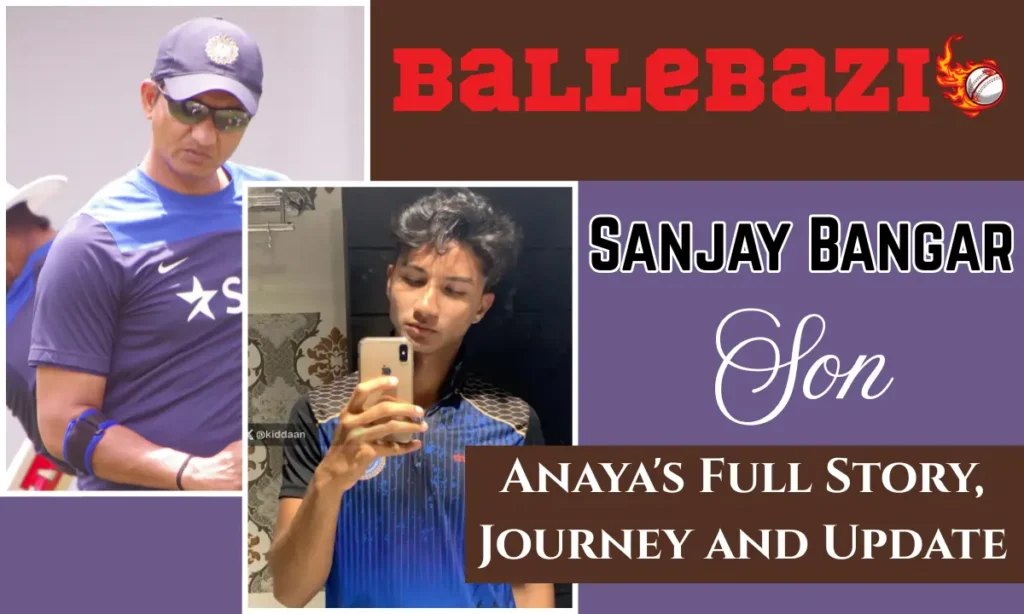

It started with a clip from 2016 in Sanjay Bangar’s Instagram reel. A young boy with a bat in his hand, still figuring it out, posing with MS Dhoni and Virat Kohli. And ended in 2024 with an entirely different person – the same soul, the same undying love for cricket, but a name, a body and a life that had traversed a path that most people sitting on their couches and scrolling would barely grasp. Anaya Bangar, daughter of former Indian batsman Sanjay Bangar and a cricketer in her own right, is 23 years old and now a transgender woman, after she completed hormone replacement therapy and surgery in 2023, changed her name, moved to Manchester and has been in the midst of one of the most visible struggles in Indian sport. The fight for the right to play the sport she has always cherished, for the person she has always been. This is her full story – who she is, what she endured, what she made of herself and how India processed it, and continues to.
Sanjay Bangar Son: The Key Facts
| DETAIL | INFORMATION |
|---|---|
| Name (birth name) | Aryan Bangar |
| Name (current) | Anaya Bangar |
| Date of birth | 2001 (age 23 as of 2024-2025) |
| Father | Sanjay Bapusaheb Bangar, former India cricketer and batting coach |
| Cricket career as Aryan | Mumbai Under-16, Pondicherry Under-19, Mumbai Under-23 trials |
| Transition | Gender-affirming surgery and hormone replacement therapy, 2023 |
| Current residence | Manchester, United Kingdom |
| Current ambition | To play women’s cricket professionally |
| ICC policy position | Banned from international women’s cricket under ICC 2023 ruling that bars any athlete who experienced male puberty, regardless of subsequent HRT or surgery |
| Scientific study | Eight-week physiological research project at Manchester Metropolitan University, January to March 2025. Results show her metrics align with cisgender female athlete standards. |
| Testosterone levels | Reduced to 0.5 nmol through HRT, at or below the typical cisgender female range |
| Key public statement | Science says I am eligible for women’s cricket. Now, the question is: is the world ready to accept the truth? |
Who Is Sanjay Bangar: Why This Story Matters in Indian Cricket
Before we understand the importance of Anaya’s story for India as a society, we need to know who her father is within the context of Indian sports. Born October 11, 1972, in Beed, Maharashtra, Sanjay Bapusaheb Bangar played 12 Tests and 15 One-Day Internationals for India, predominantly for Railways during a two-decade-long career that was one of the more sustained among domestic players in his era. Along with his tenure as batting coach for the Indian cricket team under Anil Kumble and Ravi Shastri from 2014-2019 – during which Indian batsmen from Virat Kohli to Rohit Sharma and Ajinkya Rahane all peaked – Bangar became one of India’s most respected coaching figures.
His has always been a household name in the country in connection with cricket, and in the aftermath of the initial news, his credentials would expand with roles such as head coach of the Indian Premier League’s Royal Challengers Bangalore, and head of cricket development for the Punjab Kings franchise. Sanjay Bangar is hardly an outlying figure whose famous child drew attention to his family life for the first time. He’s an insider to the highest levels of Indian cricket, the sort of person whose private affairs simply would not normally come into public discussion, simply because there’s never any opportunity.
And that’s why Anaya’s story has such social importance for India. When the reports first emerged in November 2024 about the transition of Sanjay Bangar’s son into his daughter, it didn’t come through a news item filtering out from a peripheral institution of Indian society, but one that came from within its cricketing heartland. The institution of Indian cricket is much more than just a game to this country: it’s a key vehicle for the reinforcement and representation of masculinity, ambition, family legacy, and national identity. That a story of transgender transition and gender identity has emerged from within that system, rather than from a niche one, gives it a certain additional cultural significance.
Aryan to Anaya: The Journey
Indian cricketer Aryan Bangar’s upbringing immersed her fully in the country’s sporting fraternity, thanks to her father, Sanjay Bangar – her access to coaching resources, facilities and even playing with India’s top cricketers wasn’t anything remarkable but was the common norm. Back then, the reel that made quite an impression on Instagram before it was deleted amidst huge reactions showed snippets of the athlete from 2016 onwards – photos from those years shared alongside her father and Indian cricket stalwarts like MS Dhoni and Virat Kohli. An athlete by her own right, she had competed in Mumbai’s U-16 cricket tournament and played for Pondicherry’s U-19 team; she even attended the trials of the U-23 Mumbai squad – a clear testimony of being a formidable cricketer well on her way to becoming a domestic professional. This was not just a hobby but a profession, which she personally called an “unwavering dedication to my dream accompanied by immense sacrifices and great resilience.” Alongside this journey as a cricketer, the journey of a person finding her true self was running side by side. And it came to the point in 2023 when she made the decision for hormone replacement therapy and gender affirmation surgeries, altered her name from Aryan to Anaya and moved to Manchester to pursue her cricket as well as undergo transition away from the pressures of public life in India. In her own words on the now deleted Instagram post, “While I have dedicated my life to my sport, there’s another journey that has been integral to my life. Breaking away from societal expectations and embarking on a path of self-discovery has been a significant chapter for me. I’ve had to navigate challenging terrain, shed past inhibitions, and make bold decisions to embrace my true identity.” The deleted Instagram post read, “Beyond the game, I had another journey that was even more important: the journey of self-discovery. To truly express who I am meant embracing the vulnerability that comes with authenticity, letting go of fear and standing firm in my beliefs, even when faced with adversity and judgment. Today, I stand before you, not only as a cricketer who lives and breathes this sport, but also as my complete self, unapologetically proud of who I have become. The road has undoubtedly been tough, but the personal victory of living authentically is the greatest triumph of all.”
What Indian Society Did With the Story: The Two Reactions
Anaya’s November 2024 reel went viral once Anaya posted and deleted it. Her reaction has been precisely what characterizes India’s conflicted– often self-contradictory– attitudes to gender. Ananya’s brief and fleeting time in the social-media spotlight elicited support, both vocal and sincere, from her young followers and also from LGBTQ-rights activists, who noted how courage had taken Anaya where Indian cricket was – in the past – timid. A prominent trans-identified individual having emerged from inside the cricket club’s private spaces gave a chance to discuss gender identity that those spaces (from locker rooms and commentator boxes to fan forums) – protected for so long from those discussions – had long resisted. Ananya’s reel came as close to changing how most people viewed Indian gender at that time. It’s safe to say it did not go unremarked. As expected, the public’s reception also brought a good deal of the expected outrage associated with a society whose people have recently shed most laws which restrict sexual relations, a society where trans people’s rights have been codified but remain, in many respects, highly unpopular. We heard a whole spectrum of responses, from supportive to downright hostile, from those who would use Anaya’s father to characterize the young person as either a source of disgrace or failure — a response that only shows what an ignorant person thinking about a bangar can do to make a human appear less of a Bangar than a Bangar really is. Sanjay Bangar has remained silent on his daughter’s journey of becoming who she has decided to be. This may not necessarily signal disapproval. As we have been trained to see a family’s choice to keep personal family issues on personal grounds as respect for individual privacy; in this case, we can also assume absence is the same as support. While ananya hasn’t gone into specifics about her relation with father, anayathis could be due to her respect of his privacy (and in her father’s lack of comment – some say they even go golfing. Ha)
The Harassment She Disclosed: What She Said Publicly
It was in 2024 that Anaya made the more personal public disclosures – that the harassment during her training and formative years in cricket extended to acts of sexual assault from senior cricketers, preying on her youth and a system that made her inherently susceptible. Her disclosures across multiple interviews and on social media put her at the meeting point of two deeply fraught public dialogues in India-one around her gender identity, the other regarding sexual harassment in elite sports-and in doing so she demanded scrutiny of an Indian cricket establishment that had historically remained tacit on both. The immense courage Anaya displayed through this sequence of events (She was 23, recently transitioned, living outside India, already battling with ICC and BCCI about playing women’s cricket and also exposing sexual assault allegations against cricketers) is something we need to take a moment to recognise clearly.
The Virat Kohli Training Connection: Pressure and Self-Knowledge
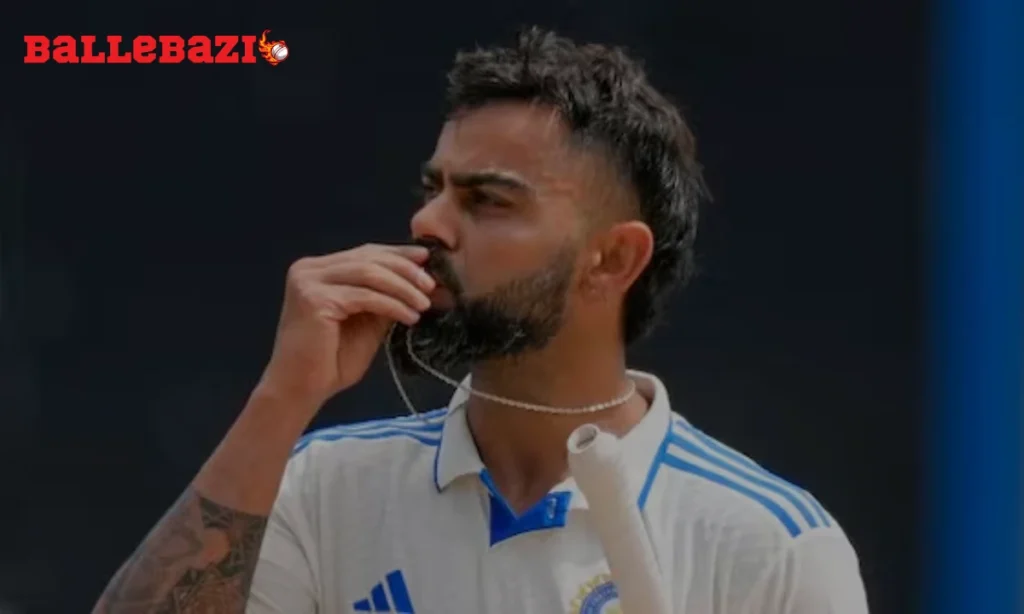
Adding another humanizing touch, in one instance of her life Anaya even played along Virat Kohli in her dad’s role as batting coach. She even revealed about the training sessions during one of her interview in 2025 with Gulf News. “I’ve met him multiple times and trained with him, alongside my dad as well. He’s given me a few tips, watched me bat, and I’ve had the chance to see him bat up close,” said Anaya. During those trainings, she also remembered asking the batting superstar about how he dealt with pressure at top notch level and he had suggested to focus on the practice to such a point where his strengths can be completely trusted. “Once you truly know yourself and your game, everything else falls into place,” recalled Anaya. The statement carried extra significance when considered that at the same point in her life, she was battling through issues while trying to continue the same form of Cricket training that later in life she would leave altogether.
The ICC Ban and the Manchester Study: Science vs Policy
Back in November 2023 the ICC had put out an announcement stating transgender cricketers would be banned from international women’s cricket, with their Article 3.7.2 making clear that “no female transgender cricketer will be eligible to participate in women’s international cricket who has experienced any part of male puberty beyond Tanner Stage 2 or after the age of 12 (whichever is earliest)”. As Anaya played junior cricket under the name of Aryan she would have certainly gone through male puberty well before any transition, so by that measure, whether or not her testosterone is low now and she has no male characteristics, it rules out any prospect of Anaya playing international women’s cricket from now on.
The England and Wales Cricket Board has since echoed those sentiments so even though she resides in Manchester and the ECB governs women’s cricket in England, all prospects of her reaching her dream career at the pinnacle of the English women’s game now stand slammed shut too. A review of the ICC policy is scheduled, but there is no room under the existing Article 3.7.2 for science to hold any sway.
Rather than taking the path of pure despair, Anaya has decided to tackle the issue with science at hand, and between January and March this year she worked on an eight-week research project with the Manchester Metropolitan University Institute of Sport with medical tests conducted measuring her glucose levels, oxygen uptake, muscle mass, haemoglobin, strength and endurance as the end result of one year of hormone treatment and intensive training. When her findings were shared publicly on Instagram along with an eight-page scientific report, it revealed that Anaya’s tested metrics were all within the ‘cisgender’ female athlete benchmark. Her testosterone levels, at 0.5 nmol, were now at or below typical female levels, and all of her metrics including power, strength, stamina and lung capacity, measured as all being within cisgender female parameters. Addressing both the BCCI and the ICC directly in formal letters, Anaya requested a move toward scientific dialogue, saying “I am talking with scientific evidence in my hand, so I hope this makes an impact and I will be hoping to BCCI and ICC talking with me and discussing this further,” and asking in a video posted on Instagram, “Science says I am eligible for women’s cricket. Now, the question is: is the world ready to accept the truth?”.
What Anaya Bangar Actually Faces: The Full Picture?
It’s useful to have the specific set of roadblocks Anaya has confronted spelled out because they are more complicated than they might appear as individually considered items. Anaya is a trans woman in India-a nation that in 2014 recognised transgender identity in law, even though much of its social and institutional infrastructure appears to have missed the memo. Anaya is from an Indian cricket family; therefore, the narrative of her transition is irrevocably intertwined with the Indian national identity, sport of enormous symbolic weight and also sport structures, BCCI and ICC, who have systematically denied her a place in the game. Anaya is living as a migrant from South Asia in the UK: which, as several journalists have commented, means her positioning is at the nexus of multiple marginalized identities, the victim of racism in white queer spaces and transphobia from among some elements of the Indian community here, and of the broader challenge of creating belonging when every space is not available to one, whole, version of you. She has also, in her story, outlined episodes of sexual assault, in a sporting culture that currently lacks appropriate structures to respond to such disclosures, especially from someone in her circumstances. This is, all of it, happening to a woman of 23, with the widely recognizable name of her father serving as the search terms by which most discover her, a perpetual indication of how her existence is already experienced through a famous male presence, rather than her own, and that she, like so many Indian women in public life, must contend with this to establish a separate life in the public eye.
The Broader Indian Context: Law, Culture, and Cricket
India’s stance on transgender issues (in law and social reality) is indeed quite complicated and often not even coherent in itself. The Supreme Court, back in 2014 in the NALSA judgement, legally defined the transgender community as a “third gender”, granting them constitutionally recognized fundamental rights. The Supreme Court also struck down Article 377 – the archaic law previously used to persecute consensual homosexual sex, which was in practice always also used against members of the transgender community – in 2018. Later, in 2019, The Transgender Persons (Protection of Rights) Act was passed by Indian Parliament in 2019 providing a legal frame to rights, though this is considered deeply flawed by LGBTQI+ advocacy. Just last October, in 2023, the same court said same-sex marriages should not be permitted; a signal that the institutional scope is limited. The Indian cricket field lies firmly within this social landscape; a sport and governing body, which may well be among the most powerful in the world but inarguably among the most social conservatives, not just with respect to cultural norms but even more to the political influence its leadership commands. The subject of Anaya’s missives – addressed directly to the Board of Control for Cricket in India (BCCI) for a science-based discussion on transgenderinclusion in sport – is an organization which has so far never needed to enter such a conversation and has demonstrated no compelling need to engage with it.
The Question the Game Cannot Avoid
The one that you read in connection with the term “Sanjay Bangar son” is amongst the real, complicated ones from the annals of recent Indian cricket. A young woman’s tale from inside the belly of the sport’s most formidable machinery. A woman with enough devotion for the game to work through pain and under the same mentors as a Virat Kohli. And a young woman facing a dilemma to be in a life not her own or renouncing the contours of all that she had been trained to call one. She picked her. Thereafter she attempted to find herself back in the game, an 8-page research thesis from a British university tucked in hand and a formal letter to the BCCI scribbled in it. Indian cricket is still considering how to put it to use. She is 23 and still awaiting a response.
Frequently Asked Questions: Sanjay Bangar Son
Who is Sanjay Bangar’s son?
Sanjay Bangar’s son Aryan is now his daughter Anaya Bangar, a 23-year-old transgender cricketer. Aryan Bangar underwent hormone replacement therapy and gender-affirming surgery in 2023, changed her name to Anaya, and moved to Manchester. She played cricket as Aryan for Mumbai Under-16, Pondicherry Under-19, and attended Mumbai Under-23 trials before her transition.
What happened to Sanjay Bangar’s son Aryan?
Sanjay Bangar’s son Aryan transitioned and is now his daughter Anaya Bangar. She underwent hormone replacement therapy and gender-affirming surgery in 2023, changed her name from Aryan to Anaya, and moved to Manchester in the UK. She went viral in November 2024 when she shared and then deleted an Instagram reel documenting her journey from 2016 to her transition, showing photographs alongside her father, MS Dhoni, and Virat Kohli.
Can Anaya Bangar play women’s cricket?
Not under current ICC policy. The ICC’s 2023 ruling on transgender athletes, specifically Article 3.7.2, bars any player who experienced male puberty from competing in international women’s cricket, regardless of subsequent hormone therapy or surgery. Since Anaya played junior cricket as Aryan, this provision permanently excludes her from international competition. She has challenged the ruling by publishing a scientific study from Manchester Metropolitan University showing her physiological metrics align with cisgender female athlete standards.
What did the Manchester University study find about Anaya Bangar?
The eight-week research project conducted at Manchester Metropolitan University between January and March 2025 measured Anaya’s glucose levels, oxygen uptake, muscle mass, haemoglobin, strength, and endurance after a year of hormone therapy and rigorous training. All metrics fell within the cisgender female athlete range. Her testosterone levels tested at 0.5 nmol, at or below the typical female range. She has submitted this eight-page scientific report formally to the BCCI and ICC as evidence for a policy review.
Has Sanjay Bangar spoken about his daughter Anaya?
Sanjay Bangar has not made any public statement about his daughter Anaya’s transition or her ongoing campaign for inclusion in women’s cricket. He has not publicly commented either to support or distance himself from her story.
Who is Sanjay Bangar?
Sanjay Bapusaheb Bangar is a former Indian international cricketer born on 11 October 1972 in Beed, Maharashtra. He played 12 Test matches and 15 One Day Internationals for India and represented Railways for two decades domestically. He served as India’s batting coach from 2014 to 2019 and has since worked as head coach of Royal Challengers Bangalore and head of cricket development for Punjab Kings.
Also Read About: Hardik Pandya Cricket Idol Wasim Jaffer: The Full Story